What is Blockchain: Architecture and Its Impact on the Global Economy
Blockchain is an innovative distributed ledger technology that enables the secure, transparent, and immutable storage of data without the need for a central, trusted authority. Its unique architecture has not only revolutionized digital payment systems but is now rapidly becoming a foundational infrastructure for optimizing and securing global business operations across multiple industries.
The Mechanism: A Distributed and Immutable Ledger
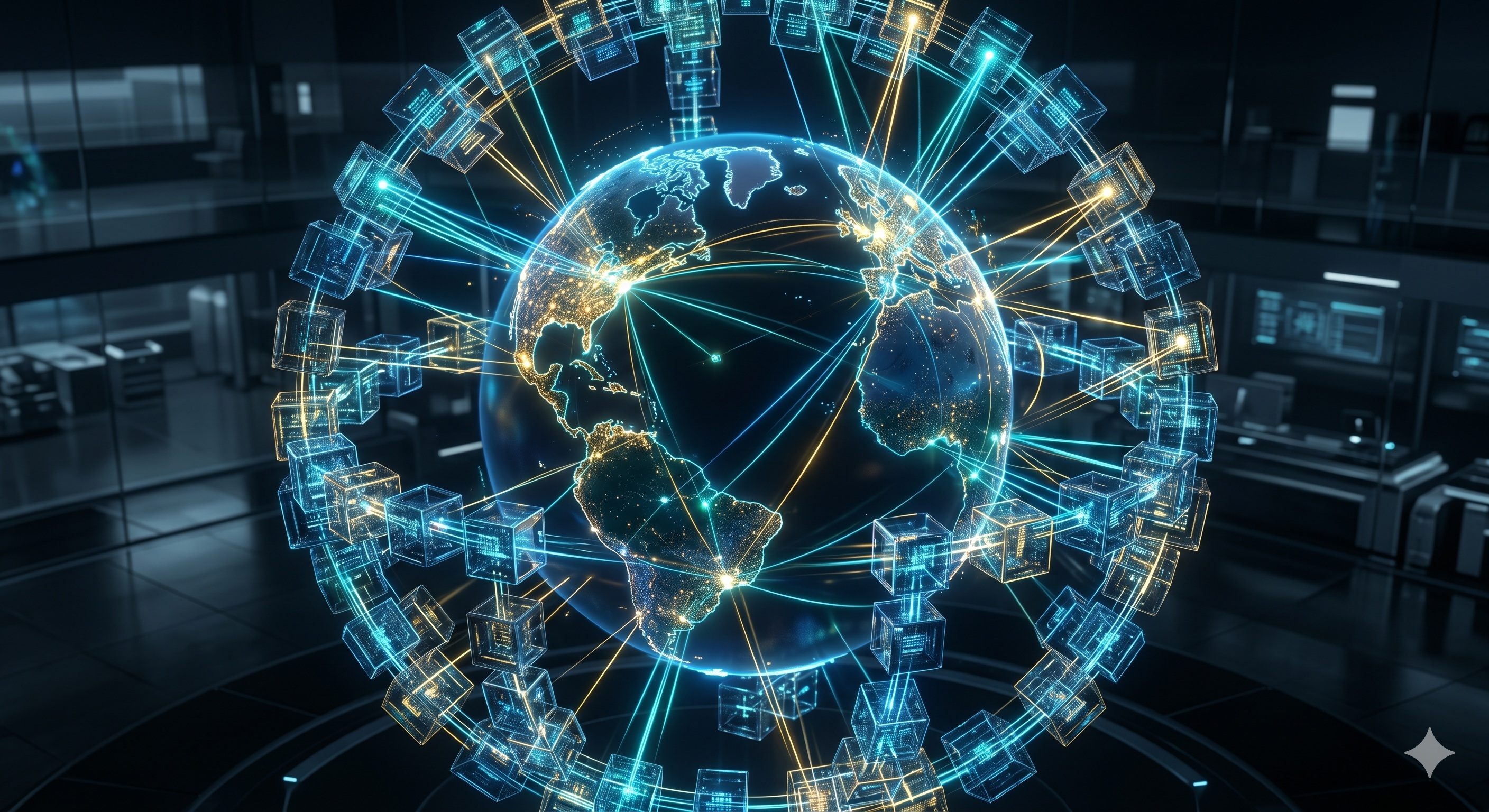
To truly understand blockchain technology, it is best to visualize it as a digital, public accounting ledger. However, instead of being stored on a single centralized server owned by a specific corporation (like a bank), an identical copy of this ledger is distributed across thousands of computers (called nodes) worldwide.
When a new transaction or data exchange occurs, this information is recorded in a "block." Once a block reaches its data capacity, it is cryptographically sealed and permanently linked to the previously filled block, creating an unbreakable "chain."
To provide deeper context, this security relies on two key concepts:
- Cryptographic Hashing: Each block contains a unique digital fingerprint (a hash) of the previous block. If anyone tries to alter a single piece of data in an old block, its hash changes, which immediately invalidates all subsequent blocks.
- Consensus Mechanisms: Before a new block is added, the majority of nodes in the network must agree that the transaction is valid (through processes like Proof of Work or Proof of Stake). Attempting to hack the system would require simultaneously altering the data on more than 50% of the computers globally, making it practically impossible from a mathematical and technological standpoint.
Practical Applications in Real-Life and Business
While blockchain was initially associated exclusively with cryptocurrencies, its enterprise applications are now vastly broader, solving highly complex operational challenges for multinational corporations.
- Supply Chain Management (Logistics and Retail): Global retail giants like Walmart utilize blockchain to trace the origin of food products. Previously, tracking the source of a contaminated batch of produce back to its original farm took the company nearly a week. By leveraging blockchain—where every step of the logistics process is permanently time-stamped and recorded—this tracing process has been reduced to just 2.2 seconds. This drastically enhances consumer safety and minimizes financial losses from broad product recalls.
- The Financial Sector and Cross-Border Payments: A traditional international wire transfer passes through multiple correspondent banks, a process that can take days and incurs high friction costs and fees. Financial institutions are deploying blockchain-based solutions to execute cross-border settlements in a matter of seconds, almost at zero cost, simply because the technology eliminates the need for clearinghouses and intermediaries.
- Smart Contracts in Insurance: A smart contract is self-executing computer code deployed on a blockchain that automatically enforces the terms of an agreement when predefined conditions are met. For example, in flight delay insurance, if an airport's database records a delay exceeding two hours, the smart contract automatically and instantly triggers a compensation payout to the passenger's account. No claim forms, manual reviews, or bureaucratic approvals are required.
- Healthcare and Patient Records: Hospitals and clinics often struggle with siloed medical data. Blockchain provides a secure framework for Electronic Health Records (EHR). A patient's medical history can be encrypted on a blockchain, granting the patient complete control over who (doctors, specialists, pharmacies) can access their data, ensuring privacy while eliminating dangerous gaps in medical history during emergencies.
How Blockchain is Changing (and Will Change) the World
The ongoing implementation of blockchain can be compared to the transformative impact the internet had in the 1990s. While the internet revolutionized the transfer of information, blockchain is revolutionizing the transfer of value and trust.
- The Elimination of Intermediaries (Disintermediation): The traditional economy relies heavily on "third parties" (notaries, banks, brokers, auditors) who charge high fees to validate transactions and establish trust. Blockchain mathematically guarantees this trust. This facilitates direct Peer-to-Peer (P2P) interactions between parties, radically reducing operational costs and accelerating administrative processes.
- Self-Sovereign Digital Identity (SSI): In an era of escalating cybercrime and massive data breaches, blockchain enables the creation of secure, decentralized digital identities. Citizens will be able to cryptographically prove their credentials (e.g., being over 18, possessing a university degree, or holding a valid license) without handing over unnecessary sensitive personal data to tech monopolies or vulnerable corporate databases.
- Tokenization of Real-World Assets (RWA): This technology allows physical and highly illiquid assets to be digitally divided into smaller, tradeable parts (tokens). Consequently, investing in premium commercial real estate, fine art, or shares in private equity becomes accessible to the average retail investor. They can purchase a fraction of the asset's value with an undeniable, mathematically backed guarantee of ownership.
- Information Integrity in the AI Era: As artificial intelligence generates increasingly realistic deepfakes and synthetic text, blockchain will serve as the ultimate verification tool. Content creators and news organizations will anchor the metadata of original photographs, videos, and articles on the blockchain, allowing anyone to verify the true origin and authenticity of digital media.
In summary, blockchain is far more than a passing technological trend; it represents a fundamental paradigm shift in digital architecture. It builds an ecosystem where transparency, accountability, and security are hardcoded into the system itself, paving the way for a more efficient, equitable, and automated global economy.

Other posts

Stay ahead with better decisions.
Get business insights today.
